
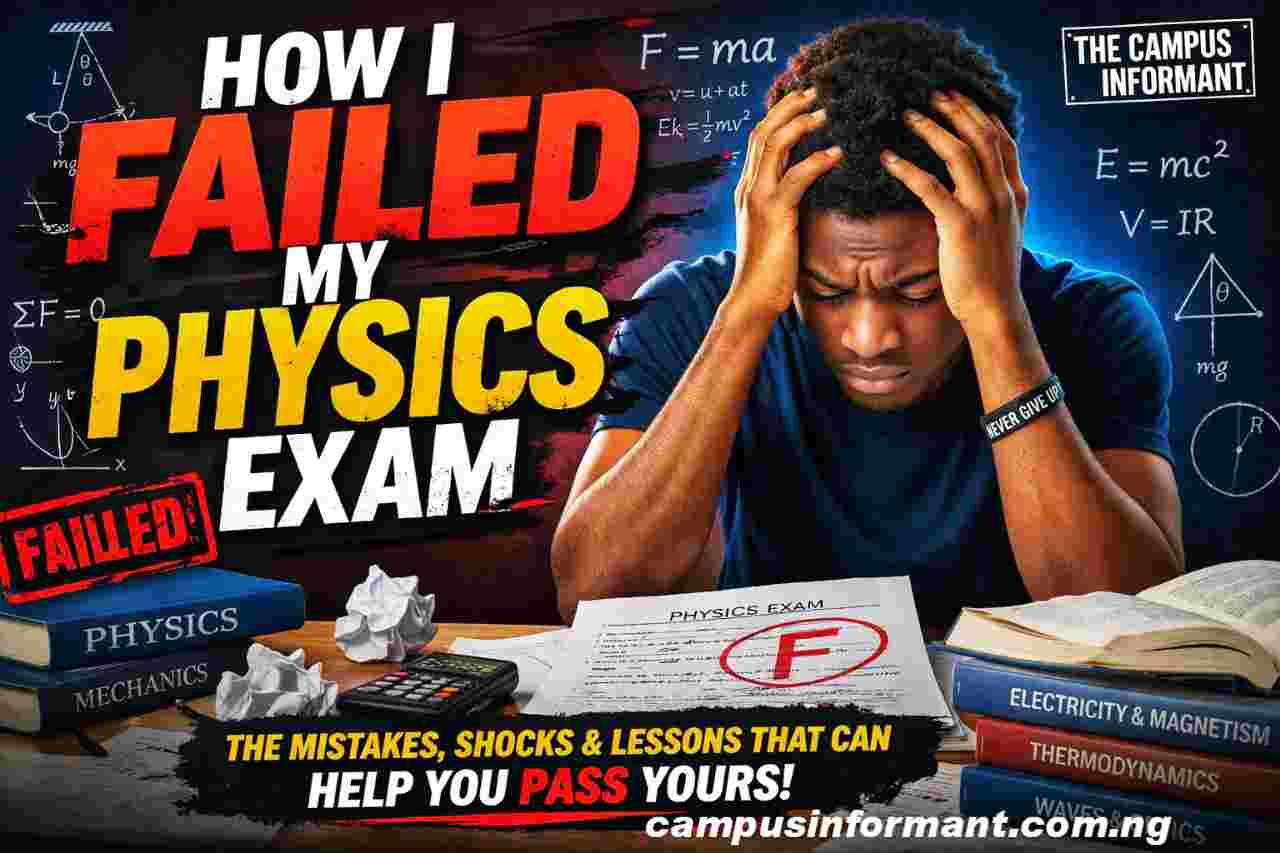
How I Failed My Physics Exam — A Correctional Guide to Help You Avoid the Same Mistakes: Physics is one of those courses many students fear even before stepping into the exam hall. Some people study for weeks, attend lectures regularly, and still end up shocked by their results. I learned the hard way that failing Physics is rarely about intelligence — most times, it comes from preparation mistakes students don’t even realize they are making.
Remember this story is not a true life story but we got the information online for education purposes.
This article is a reflection and correctional guide based on common problems that make students fail Physics, even when they genuinely read their books. If you have ever said, “But I actually studied!”, then this is for you.

Why Students Fail Physics Even After Reading
Many students approach Physics the same way they study theory-based courses — by reading notes repeatedly and memorizing definitions. Unfortunately, Physics does not reward passive reading.
Physics tests three major abilities:
- Understanding concepts
- Applying formulas correctly
- Solving unfamiliar problems logically
Reading without practicing problem-solving is one of the fastest ways to struggle in Physics exams.
1. Memorizing Instead of Understanding Concepts
One major mistake students make is trying to memorize formulas without understanding where they come from or when to use them.
For example, students may memorize equations for motion but panic when a question is presented differently from classroom examples.
Physics questions are often twisted slightly to test understanding, not memory.
What You Should Do Instead
Focus on understanding:
- What each formula represents
- The meaning of variables
- Real-life applications of concepts
When you understand the concept, you can solve even unfamiliar questions.
2. Avoiding Numerical Practice
Physics is practical thinking disguised as theory.
Some students read solved examples but avoid solving problems themselves because calculations feel stressful. During exams, this becomes a serious disadvantage.
You cannot learn Physics by watching solutions alone.
- Correction Strategy
- Solve problems daily.
- Attempt questions before checking answers.
Practice calculations without shortcuts.
Consistency builds confidence.
3. Weak Mathematical Foundation
Physics and Mathematics are closely connected. Many students actually struggle with Physics because of weaknesses in basic math skills such as:
- Algebra manipulation
- Fractions and indices
- Rearranging equations
- Basic arithmetic accuracy
Even when students understand the concept, poor calculation skills lead to wrong answers.
How to Improve
Revise essential mathematics alongside Physics. Strengthening math skills automatically improves Physics performance.
4. Ignoring Units and Measurements
Another silent reason students lose marks is neglecting units.
In Physics:
Units confirm whether your solution makes sense.
Missing or incorrect units can cost marks even when calculations are correct.
Students often rush through answers and forget this important detail.
Exam Tip
Always check:
- Units given in the question
- Required unit of the final answer
- Necessary conversions (e.g., cm to m)
5. Studying Physics Only Before Exams
Physics requires gradual understanding. Last-minute reading rarely works because concepts build upon each other.
Students who postpone studying until exam week usually struggle to connect topics like motion, energy, electricity, and waves.
Better Approach
Study Physics in small portions regularly instead of marathon reading sessions.
6. Fear and Mental Block Toward Physics
Many students enter the exam hall already convinced Physics is difficult. This mindset affects performance more than they realize.
Fear leads to:
- Panic during calculations
- Misreading questions
- Giving up too quickly
Confidence grows through practice, not avoidance.
7. Not Studying Past Questions
Physics exams often repeat concepts even when questions look different.
Students who ignore past questions miss the opportunity to understand:
- Common problem patterns
- Frequently tested topics
- Examiner expectations
- Smart Preparation Method
Practice past questions under timed conditions. This trains both speed and accuracy.
8. Poor Interpretation of Questions
Sometimes students know the topic but misunderstand what the question is asking.
Physics questions may require:
- Finding acceleration instead of velocity
- Calculating change rather than total value
- Interpreting diagrams carefully
- Rushing leads to avoidable mistakes.
Correction Tip
Read each question twice before solving.
Practical Steps to Avoid Failing Physics Again
Here is a simple action plan you can follow:
Step 1: Understand Before Memorizing
Ask “why” and “how,” not just “what.”
Step 2: Practice Problems Daily
Even 5–10 questions per day can make a huge difference.
Step 3: Strengthen Your Mathematics
Physics becomes easier when calculations become natural.
Step 4: Use Past Questions Strategically
Identify repeated concepts and master them.
Step 5: Review Your Errors
Every mistake shows exactly what you need to improve.
Final Thoughts: Failure Can Become Your Strongest Lesson
“Please note that this article is not based on a personal experience. It was carefully compiled from commonly shared student experiences and verified academic insights gathered online, which we considered valuable enough”
Failing a Physics exam can feel discouraging, especially when effort was involved. But most failures come from wrong study methods, not lack of ability.
Physics rewards understanding, patience, and consistent practice. Once you change your approach from memorizing to problem-solving, improvement becomes visible quickly.
Instead of seeing failure as the end, treat it as feedback — a guide showing you how to study smarter next time.
Many students who once struggled with Physics later discovered it became one of their strongest subjects after adjusting their strategy. You can do the same.
Follow us on our WhatsApp channel by CLICKING HERE and you can comment through the comments section if you have any questions or contributions.
